Old Nose Injury Still Affecting Your Breathing? Rhinoplasty Can Fix
A nose injury can heal on the outside and still leave a problem on the inside. The bruising fades. The swelling goes down. The nose looks normal again.
But years later, some patients tell us they're still breathing through their mouth at night. Still feeling blocked on one side. Still wondering why they can never get a full breath in.
If this sounds familiar, it's not in your imagination. In our clinical experience, an old injury can quietly change the structure inside the nose, and that change doesn't always resolve on its own with time.
Why an Old Injury Is Still Affecting You Today
The nose isn't just cartilage and skin on the outside. Inside, there's a wall called the septum that divides the nostrils, along with passages that control how air moves in and out.
When the nose is hit during sports, an accident, or even a fall in childhood, that internal structure can shift. Sometimes the shift is only slight, slight enough that it wasn't flagged as a concern at the time, because the injury itself didn't seem serious.
But a small shift can be enough to affect airflow on one side. Over the years, this can sometimes progress. Scar tissue may build up, and cartilage can continue to shift as a person grows older. What started as a minor injury can, in some cases, become a long-term breathing concern.
Signs Your Breathing Trouble Might Be Linked to an Old Injury
Many people live with this for years without connecting the dots. Some signs we look for during an assessment include:
- Breathing more easily through one nostril than the other
- Waking up frequently with a dry mouth or sore throat
- Snoring that has gradually worsened
- Feeling out of breath faster than expected, even during light activity
- A nose that appears slightly crooked or uneven compared with older photos
None of these symptoms feel dramatic on their own. That's part of why they often go unaddressed for years.
It's Not "Just How You're Built"
One of the most common assumptions patients bring to us is that a blocked nostril, or breathing that feels harder than it should, is simply their natural anatomy.
Sometimes that is the case. But if there's a history of nose injury, even one that seemed minor at the time, the breathing difficulty may trace back to that injury rather than to natural anatomy alone.
The only reliable way to know the difference is a proper examination. As specialists, we can look inside the nose and assess whether the airway is affected by old injury-related changes, or whether it reflects the person's natural shape.
What's Actually Happening Inside
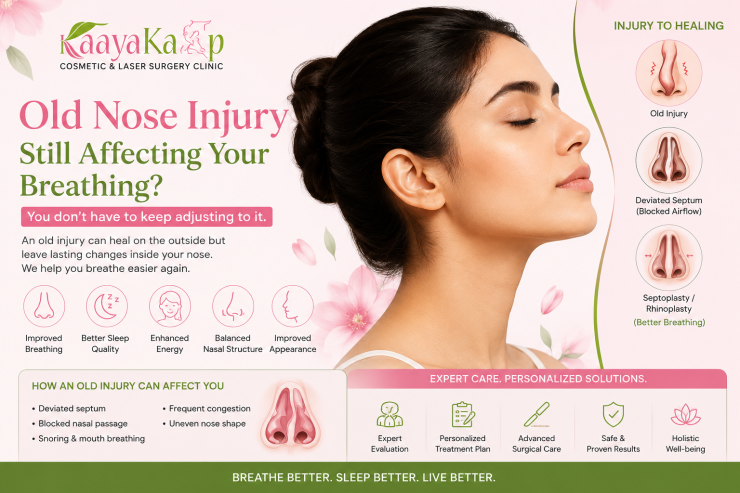
When the septum shifts after an injury, this is referred to as a deviated septum. Picture a hallway meant to run straight down the middle of a room. If that hallway bends to one side, less space remains on that side for air to pass through.
This is broadly what can happen inside the nose after trauma. The deviation may be barely visible from the outside, but the effect on airflow can still be significant on the inside. Over time, this may also affect sleep quality, energy levels, and sense of smell in some patients.
Can This Actually Be Fixed?
In many cases, yes. A deviated septum or structural change from an old injury can often be corrected, though the right approach depends on the individual case. As with any surgical procedure, individual results may vary, and outcomes depend on each patient's specific anatomy and healing.
Depending on assessment, this may involve:
- Septoplasty: Straightening the internal wall of the nose to help restore airflow
- Rhinoplasty: Addressing the external shape, particularly if the injury also affected how the nose looks
When both breathing and appearance are affected, these two procedures are sometimes combined, following a full clinical evaluation.
What to Expect From the Process
We always begin with a thorough assessment, not a quick decision. This typically includes:
- A detailed discussion of injury history and current symptoms
- A physical examination of the nasal structure
- Imaging, where needed, for a clearer internal view
From there, patients understand what may be causing their breathing difficulty and what their options could be. Recovery is generally manageable for most patients, though timelines vary and should be discussed individually with your treating doctor.
Why People Wait Years Before Getting This Checked
It's common to delay this kind of evaluation. Some assume nothing can be done so long after the injury. Others see it as a purely cosmetic decision rather than a medical one. For some, it simply slips down the priority list, year after year.
But breathing well isn't a small thing. It can affect sleep, daily energy, and overall wellbeing. If an old injury may be contributing to ongoing nasal blockage, it's worth having it properly assessed rather than assuming nothing can be done.
A Word on Cost
One of the first questions patients often ask is about the general cost of rhinoplasty or septoplasty in Kolkata. As a broad indicative range, this typically falls between ₹70,000 and ₹1,80,000, with combined procedures (septoplasty plus rhinoplasty) generally on the higher end though this varies significantly based on whether the septum, the external shape, or both need correction, and the technique used.
This is only an approximate guide. An accurate, personalised estimate is only possible after a proper in-person consultation.
You Don't Have to Keep Adjusting to It
If you've spent years assuming your breathing pattern is simply how you're built, it may be worth asking a different question: what changed after that old injury, and can it be assessed now?
At Kaayakalp, we begin with an honest conversation about what you're experiencing. As always, individual results may vary, and we recommend every patient consult their treating doctor for a personalised assessment before deciding on any procedure.
About the Author: Dr. V. S. Rathore, Cosmetic Surgeon & Hair Transplant Surgeon MBBS, MS (General Surgery), MCh (Plastic Surgery)
Frequently Asked Questions
1. Can a nose injury affect breathing even years later?
Yes, this is more common than many people realise. An injury that seemed minor at the time can still shift the internal structure of the nose. That shift doesn't always cause noticeable problems right away, but it can progress over the years in some cases, contributing to breathing difficulty later on. Individual experiences vary, and a proper assessment is the only way to confirm the cause.
2. How do I know if I have a deviated septum from an old injury?
Common indicators include breathing more easily through one nostril than the other, frequent snoring, waking up with a dry mouth, or feeling out of breath faster than expected. The only reliable way to confirm this is through a physical examination by a specialist. We recommend consulting your treating doctor for a personalized assessment.
3. Is surgery the only way to fix breathing problems from an old injury?
In many cases involving structural changes like a deviated septum, surgery is often the most effective long-term approach. Some minor symptoms may be managed conservatively, but if the underlying structure has shifted, this typically won't resolve without correction. This should be discussed individually with your treating doctor.
4. Can the surgery fix both my breathing and the shape of my nose?
In many cases, yes. When an injury has affected both the airway and the outer appearance, septoplasty and rhinoplasty may be performed together following assessment. As with all procedures, individual results may vary, and suitability depends on each patient's specific case.
5. What does rhinoplasty or septoplasty cost in Kolkata usually depend on?
Cost depends on several factors: whether only the septum needs correction, whether the external shape also needs work, and the overall complexity of the case. A specialist consultation is the only way to get an accurate, personalised estimate.
Disclaimer: This article is for general informational and educational purposes only and does not constitute medical advice. Individual results may vary from person to person. Please consult your treating doctor for a personalised assessment before making any decisions regarding treatment.