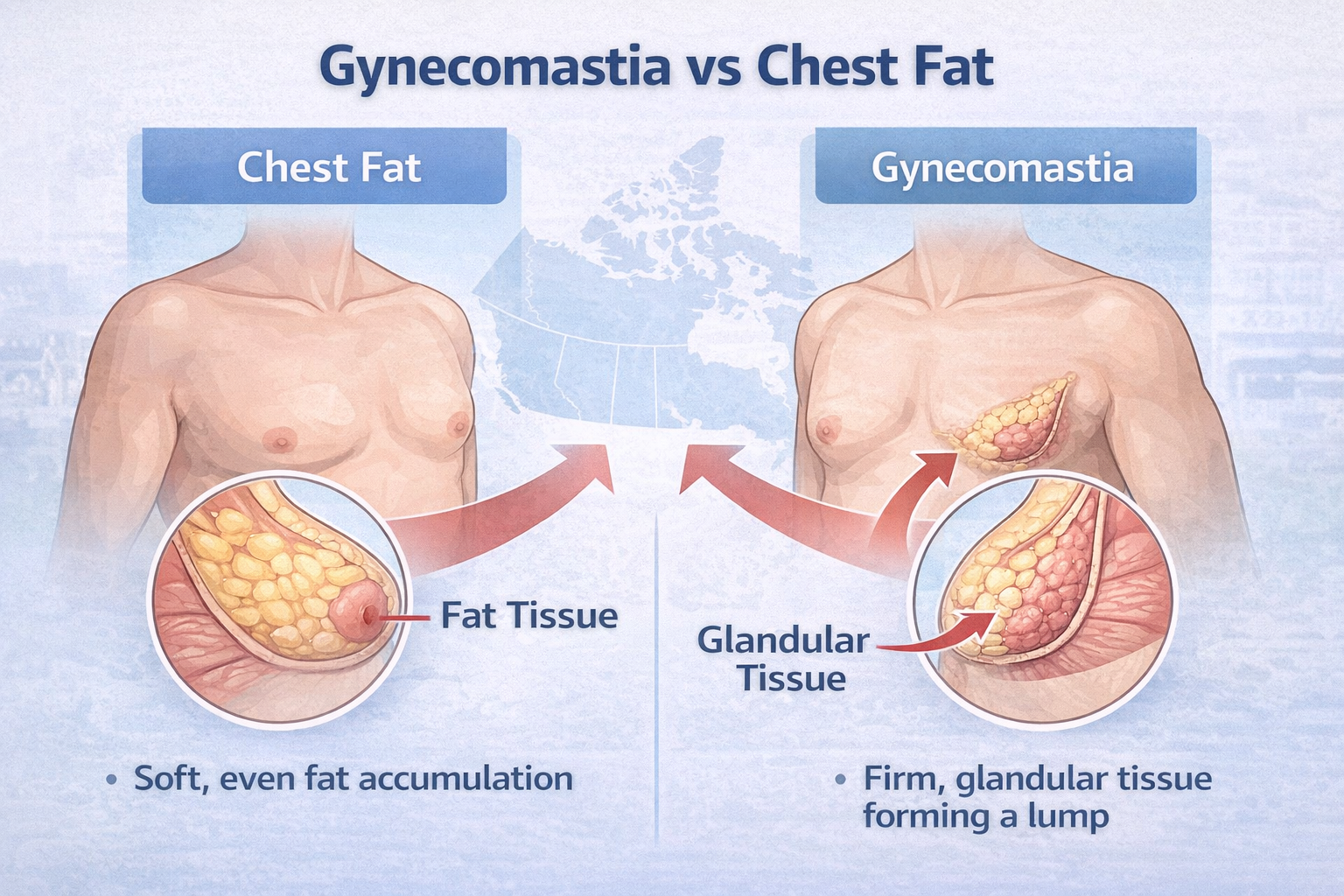
How to Tell If It’s Gynecomastia or Just Chest Fat?
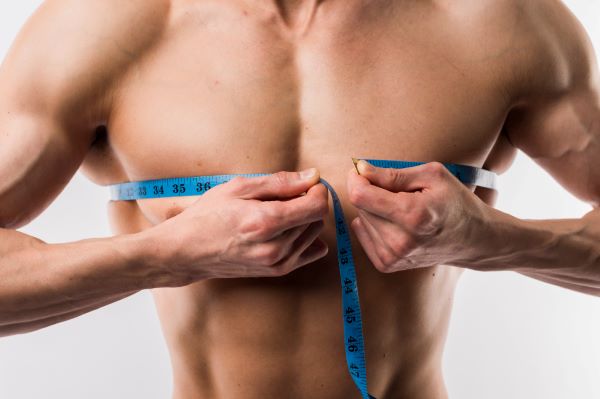
Many men notice it but don't talk about it. A chest that looks rounder than it should, a puffiness that doesn't go away no matter how much you train — it affects confidence quietly but deeply. Before you can fix it, you need to understand what's actually causing it. Gynecomastia vs chest fat may look the same in the mirror, but they're two very different things — and the treatment for each is completely different too.
What's the Actual Difference Between Gynecomastia and Chest Fat?
Gynecomastia is the growth of real glandular tissue in a man's chest, caused by a hormonal imbalance between oestrogen and testosterone. It can develop during puberty, due to certain medications, or as hormones shift with age. Crucially — it has nothing to do with your weight or diet.
Chest fat (pseudogynecomastia) is simply fat that has accumulated in the chest area due to weight gain. No hormonal issue, no abnormal tissue growth — just fat sitting in a very noticeable place.
They can look almost identical from the outside. That's where the confusion starts — and that's exactly what we're here to help you sort out.
Can You Tell the Difference at Home? Try the Pinch Test
The pinch test is the simplest way to get your first clue. Here's how to do it:
- Stand comfortably with your arms slightly relaxed at your sides
- Using your thumb and index finger, gently pinch the tissue starting from right behind your nipple and slowly move outward
What you might feel:
- Firm, rubbery, or disc-like tissue sitting right behind the nipple that doesn't move around loosely — more likely glandular tissue, pointing towards gynecomastia
- Soft, squishy tissue that feels similar to pinching your belly or sides — more characteristic of chest fat
The pinch test is a helpful starting point, not a final diagnosis. Some men have both glandular tissue and fat present at the same time, which makes self-assessment unreliable. A surgeon's examination will always give you a clearer, more accurate answer.
Does Your Chest Change When You Lose Weight?
This is one of the most telling questions to ask yourself. Here's a simple way to read the signs:
- Lost weight overall but your chest looks exactly the same? Strong indicator of gynecomastia — glandular tissue cannot be burned off through diet or exercise, no matter how disciplined you are
- Chest improves somewhat with weight loss but never fully resolves? Could be a combination of both conditions
- Chest reduces noticeably as you lose weight? More likely to be chest fat
Is There a Lump Behind Your Nipple?
Run your fingers gently around the nipple area and notice what you feel:
- Gynecomastia typically presents as a firm, button-like or disc-shaped lump concentrated directly beneath the nipple — distinct, localised, and hard to miss
- Chest fat is more spread out, softer, and feels consistent with fat elsewhere on your body — no specific focal point
If you can feel a defined lump that's been there for months and isn't going away, it's worth getting it properly examined.
Does It Affect One Side or Both?
Chest fat is generally distributed across both sides of the chest fairly evenly. Gynecomastia, however, can affect just one side — or affect both sides but unevenly. If you've noticed that one side of your chest is noticeably fuller or has a firmer lump than the other, gynecomastia is a strong possibility and a consultation becomes even more important.
Is There Any Tenderness or Sensitivity Around the Nipple?
- Chest fat — usually no discomfort at all
- Gynecomastia — often comes with mild tenderness, soreness, or sensitivity around the nipple, particularly when it's in an active or developing phase
If your chest feels tender specifically around the nipple area — not the whole chest — mention it during your consultation. It's a useful clinical detail.
What Actually Works to Treat Each Condition?
For chest fat: Liposuction is the most precise and permanent solution, especially for fat that hasn't responded to diet and exercise. It's minimally invasive with a relatively quick recovery.
For gynecomastia: Surgery is the only effective treatment. No cream, supplement, or training programme will remove glandular tissue. Surgical excision is the standard, proven approach — and when done well, it's a permanent, one-time correction.
When both are present: A combined approach — gland removal along with liposuction — gives the most complete and natural-looking result.
Many men also want to understand gynecomastia surgery cost in Kolkata before taking things forward — which is completely fair. The cost depends on what your chest specifically needs, the technique involved, and the extent of correction required. A proper consultation will give you a fully transparent, personalised breakdown with no ambiguity.
You Don't Have to Keep Guessing
The signs above can give you a good initial sense of what you're dealing with. But a proper clinical examination — and if needed, an ultrasound — is the only way to know for certain.
At Kaayakalp, the first step is always a thorough, honest assessment. Come in, get the right answers, and understand exactly what your options are — clearly, without pressure.
Frequently Asked Questions (FAQs)
1. I felt a firm lump behind my nipple during the pinch test — how soon should I get it checked?
There's no need to panic, but don't keep putting it off either. A firm lump that's been there for more than a few months is unlikely to go away on its own — especially if you're past your teenage years. Getting it checked sooner means getting clarity sooner, and if treatment is needed, earlier intervention generally gives better results. Book a consultation and let a surgeon give you a proper assessment.
2. I've been going to the gym for over a year and my chest hasn't changed at all — could it be gynecomastia?
That's honestly one of the most common stories we hear. A man puts in consistent effort, sees progress everywhere else, but the chest stays the same — and that's deeply frustrating. If that's your experience, gynecomastia is very likely what you're dealing with. Glandular tissue is completely unaffected by exercise or diet, so no matter how hard you train, it simply won't budge. A consultation will confirm it and give you a clear path forward.
3. Can gynecomastia go away on its own without surgery?
In teenage boys, gynecomastia during puberty sometimes resolves on its own within one to two years as hormones stabilize. However, if it has persisted beyond the age of 18, the chances of it resolving naturally are very low. In adult men, gynecomastia almost always requires surgical treatment for a permanent result.
4. What does recovery after gynecomastia surgery actually look like day by day?
- Day 1–2: Rest, mild soreness, compression vest on
- Day 3–4: Moving around comfortably at home
- Day 5: Most men return to desk work
- Week 2–3: Swelling gradually reduces, results start becoming visible
- Week 4: Light activity resumes, compression vest comes off
- Month 2–3: Final results fully settle in
Most men are genuinely surprised by how manageable the recovery is — and how quickly they start seeing the difference.
5. Is gynecomastia surgery cost in Kolkata very high? What does it actually include?
Kolkata offers very good quality care at costs that are significantly more accessible than cities like Mumbai or Bangalore. The overall cost typically covers:
- Surgeon's fee
- Anaesthesia charges
- Facility and OT charges
- Compression garment
- Follow-up consultations
The exact figure depends on whether you need gland excision, liposuction, or a combination of both. At your Kaayakalp consultation, you'll receive a clear, itemised estimate — so you know exactly what you're paying for and why.