5 Common Botox Myths That Might Surprise You
You've seen it on social media. You've heard your friends talk about it. Maybe you've even Googled it at midnight wondering if it's really safe.
Botox is one of the most talked-about treatments in the world of cosmetic care. And yet, it's also one of the most misunderstood.
The problem? There is a lot of misinformation about Botox, which can make it difficult for people to make informed decisions about treatment.
So here are some common myths that we will address for you, so that it doesn’t stand in between you and your decision.
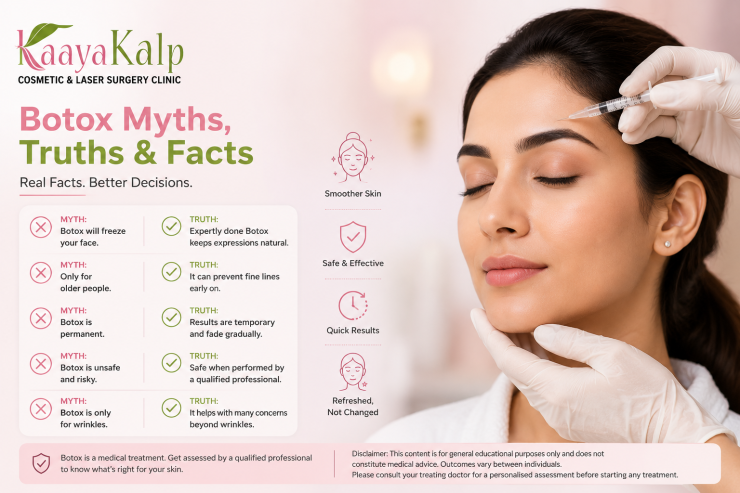
Myth 1: Botox Will Freeze Your Face
This is probably the most common fear people have.
You've seen photos online of celebrities who look stiff, expressionless, almost plastic. And you've assumed, that's what Botox does.
Here's the truth.
That frozen look happens when too much is used, in the wrong places, by someone who isn't skilled enough. It's not what Botox is supposed to do.
When done correctly, Botox relaxes only the specific muscles causing wrinkles. Everything else - your smile, your expressions, your natural face stays exactly as it is.
The goal is never to change how you look. It's to help you look like a more rested, refreshed version of yourself.
A qualified doctor assesses the facial muscles, treatment goals, and appropriate dose before recommending treatment. That balance is everything.
Myth 2: Botox Is Only for Older People
A lot of people think Botox is something you consider only after wrinkles have already settled in. Only for people in their 40s or 50s.
That's not quite right either.
Many people in their late 20s and early 30s use Botox as a preventive step. Fine lines form slowly over years of repeated expressions like squinting, frowning, smiling. Some people choose Botox as a preventive approach after consultation with a qualified doctor, although suitability varies from person to person.
It doesn't mean everyone should rush to get it young. But age alone is not the deciding factor.
What matters more is:
- Whether visible lines are bothering you
- Whether those lines are there even when your face is relaxed
- Whether you're in good general health
- Whether you've had a proper consultation with a qualified doctor
Botox is not about age. It's about what your skin needs and what outcome you're looking for.
Myth 3: Botox Is Permanent - Once You Start, You Can't Stop
Many people avoid Botox entirely because they believe once they start, they're locked in forever. That if they stop, their face will look worse than before. This creates unnecessary worry among people.
Neither of these things is true.
Botox wears off naturally. Depending on the person and the area treated, results typically last between 3 to 6 months. After that, the muscles slowly return to how they were. As the effects wear off, muscle activity gradually returns and your appearance typically returns to its pre-treatment state.
There is no permanent change. There is no dependency. Stopping Botox simply means your face returns to where it was before you started.
Some people do choose to continue with regular sessions because they like the results. But that's a personal choice and not something the treatment forces on you.
Note: Everyone's skin, muscle response, and healing pattern is different, so individual results may vary from person to person.
Myth 4: Botox Is Unsafe and Full of Side Effects
The word "toxin" in the name makes people nervous. Understandably so.
But here's some important context.
Botox has been used in medical treatments for decades, long before it became popular in cosmetic care. It has been studied extensively and is approved for use by regulatory bodies across the world, including in India.
When used appropriately by a qualified medical professional for suitable patients, Botox has a well-established safety profile.
Common side effects are mild and temporary:
- Slight redness or swelling at the injection site
- A small bruise that fades within a few days
- Mild sensitivity for a short period after the session
Serious side effects are rare and almost always linked to incorrect technique or the wrong dose being used.
For safety and appropriate treatment planning, Botox should be administered by a qualified medical professional after a proper clinical assessment.
Myth 5: Botox Is Only for Wrinkles
Ask most people what Botox does and they'll say, it removes wrinkles.
That's true. But it's far from the whole picture.
Botox may be used for a wider range of concerns than many people realise, depending on the individual's clinical assessment:
| Concern | How Botox Helps |
| Forehead lines and frown lines | Smooths and relaxes the muscles that cause them |
| Crow's feet near the eyes | Softens the lines formed from squinting and smiling |
| Lip lines | Gently relaxes overused muscles around the mouth |
| Jaw clenching or teeth grinding | Relaxes the jaw muscle to reduce tension and discomfort |
| Gummy smile | Adjusts how much of the gum shows when you smile |
| Excessive sweating | Blocks the signals that trigger sweat in targeted areas |
| Neck bands | Softens visible vertical lines on the neck |
It's a much more versatile treatment than most people give it credit for. And for many of these concerns, it is one of the commonly used non-surgical treatment options for selected indications following clinical assessment.
Note: Everyone's skin, muscle response, and healing pattern is different, so individual results may vary from person to person.
Know What's True for Your Skin
Myths can be powerful. Understanding the facts can help you have a more informed discussion with your treating doctor.
Botox is a medical treatment that may be appropriate for selected patients after a proper clinical evaluation.
Before you decide based on something you heard or read online, always get the facts right by consulting a qualified doctor for a personalized assessment before undergoing any cosmetic treatment.
If you are considering Botox treatment, consult a qualified cosmetic or plastic surgeon to understand whether it is appropriate for your concerns.
Author: Dr. V S Rathore, M.B.B.S. (Hons) MS, M. Ch, Plastic, Cosmetic & Reconstructive Surgeon
Frequently Asked Questions
1. How long does Botox last on the face?
Results typically last between 3 to 6 months depending on the area treated, the amount used, and how your body responds. First-time patients sometimes find it wears off slightly faster. Treatment duration varies between individuals and repeated treatments may influence how long the effects last.
2. How much does Botox cost in Kolkata?
Botox pricing depends on the number of areas treated, the amount of product used, and the clinic you choose. Rather than a fixed number, most clinics quote this after an in-person consultation, since your exact requirement determines the cost. Ask for a written estimate before your first session so there are no surprises, and your doctor can give you an exact quote based on your specific needs.
3. How often should I get Botox on my face?
Most people schedule a follow-up session every 3 to 4 months to maintain their results. Over time, some patients need sessions less frequently as the treatment intervals may vary depending on your individual response and clinical assessment.
4. Can Botox be injected anywhere on the face?
Botox can be used on several areas like the forehead, between the brows, around the eyes, around the lips, along the jaw, and on the neck. Each area requires a different amount and technique. Only a trained professional should decide what's appropriate for your specific face and concern.
5. Is one Botox session enough to see results?
Yes, results from a single session are usually visible within 4 to 7 days and fully settled by two weeks. However, some people with deeper lines may need a follow-up assessment after the first session to fine-tune the results. Since everyone's skin, muscle response, and healing pattern is different, individual results may vary from person to person so your doctor will advise you based on your individual response.
Disclaimer: This content is for general educational purposes only and does not constitute medical advice. Outcomes vary between individuals. Please consult your treating doctor for a personalised assessment before starting any treatment.