Receding Hairline vs Crown Thinning: A Scientific and Strategic Approach to Hair Transplantation
Hair loss is not merely a cosmetic concern—it is a progressive biological condition that requires precise diagnosis, scientific planning, and long-term management. Among the various patterns of androgenetic alopecia, the two most commonly encountered in clinical practice are receding hairline and crown thinning. While both arise from the same hormonal mechanism, their progression, aesthetic impact, and surgical management differ significantly.
At Kaayakalp Cosmetic & Laser Clinic, Kolkata, hair transplantation is approached as a medically guided, long-term restoration strategy rather than a short-term cosmetic procedure. Understanding the distinction between these two patterns is essential for achieving natural, sustainable, and age-appropriate outcomes.
The Biological Basis of Pattern Hair Loss
Both receding hairline and crown thinning are manifestations of androgenetic alopecia, a genetically determined condition mediated by dihydrotestosterone (DHT). Hair follicles in androgen-sensitive regions gradually undergo miniaturisation, producing thinner and shorter hairs until visible density is lost.
Hair transplantation is based on the principle of donor dominance, wherein follicles harvested from the occipital scalp—the “safe donor zone”—are genetically resistant to DHT. When transplanted into thinning or bald areas, these follicles continue to grow permanently.
With modern surgical techniques and meticulous graft handling, hair transplantation achieves graft survival rates exceeding 90–95%, ensuring predictable and durable results.
Receding Hairline: Clinical Characteristics and Surgical Priorities
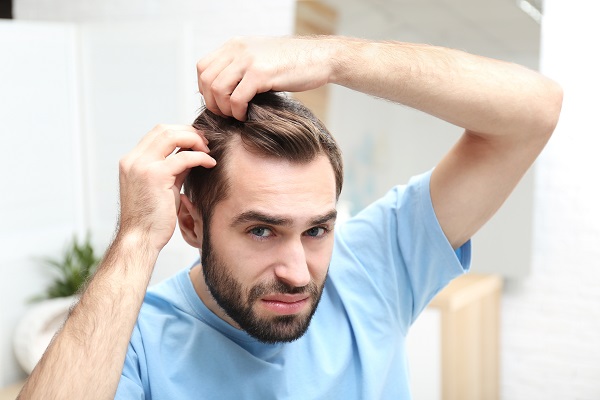
Hairline recession typically begins at the temples and frontal scalp, progressing in a predictable pattern. Because the frontal hairline defines facial framing and perceived youthfulness, even early-stage recession can significantly affect appearance.
Hairline transplantation requires exceptional surgical precision. Critical factors include:
• Designing a hairline appropriate for the patient’s age, facial proportions, and anticipated future hair loss
• Creating natural irregularity to replicate physiological hair distribution
• Ensuring precise angulation and direction of graft placement
• Establishing appropriate density gradients to produce a natural visual transition
Hairline restoration prioritizes aesthetic refinement and long-term natural appearance rather than graft quantity alone.
Crown Thinning: Unique Surgical Considerations
Crown thinning, or vertex alopecia, progresses in a centrifugal pattern from the central whorl. Due to its circular geometry and complex hair orientation, crown restoration is technically demanding.
Compared to frontal restoration, crown transplantation typically requires significantly more grafts—often 1.5 to 2 times more—to achieve comparable visual density.
Key surgical principles include:
• Accurate recreation of the natural hair whorl pattern
• Strategic graft distribution to maximize density perception
• Conservative donor utilization to preserve future transplant options
• Integration with medical therapy when necessary to stabilize ongoing hair loss
In many patients, crown restoration is approached conservatively to prioritize long-term donor preservation.
Donor Area Management: The Foundation of Sustainable Hair Restoration
The donor area represents a finite biological resource. Proper evaluation and preservation are essential to ensure sustainable results throughout the patient’s lifetime.
At Kaayakalp Cosmetic & Laser Clinic, donor assessment includes:
• Donor density evaluation
• Scalp laxity assessment
• Hair shaft calibre and follicular unit analysis
• Long-term projection of hair loss progression
This comprehensive approach ensures optimal graft utilization and prevents donor depletion.
FUE and FUT: Scientifically Established Hair Transplant Techniques
Modern hair transplantation utilises two primary donor harvesting techniques: Follicular Unit Extraction (FUE) and Follicular Unit Transplantation (FUT).
Follicular Unit Extraction (FUE)
FUE involves individual extraction of follicular units using specialized micro-instruments.
It is particularly suitable for:
• Patients who prefer short hairstyles
• Patients wishing to avoid a linear donor scar
• Patients requiring selective donor harvesting
FUE provides excellent outcomes when performed with precise surgical technique and responsible donor management.
Follicular Unit Transplantation (FUT)
FUT involves harvesting a strip of donor scalp followed by microscopic dissection into individual follicular units.
FUT remains an excellent option for:
• Patients requiring larger graft numbers
• Patients with favourable scalp laxity
• Patients requiring optimal donor preservation
FUT provides high graft yield, excellent follicular quality, and predictable long-term outcomes.
Importantly, both FUT and FUE produce equally natural aesthetic results when performed with appropriate surgical expertise.
Technique Selection: Individualized and Scientifically Guided
The choice between FUE and FUT depends on:
• Donor area characteristics
• Extent and pattern of hair loss
• Long-term graft requirements
• Patient hairstyle preferences
• Future progression of androgenetic alopecia
At Kaayakalp Cosmetic & Laser Clinic, technique selection is based entirely on scientific principles, long-term planning, and patient-specific factors.
The Kaayakalp Approach to Hair Transplantation
Under the leadership of Dr. Vikram Singh Rathore, MS, MCh (Plastic Surgery), Kolkata, hair transplantation at Kaayakalp Cosmetic & Laser Clinic is performed with a strong emphasis on precision, safety, and long-term outcome optimization.
The Kaayakalp protocol includes:
• Comprehensive scalp and donor area evaluation
• Individualized hairline design based on facial anatomy and ageing patterns
• Conservative graft allocation to preserve donor reserves
• Precise graft placement to replicate natural hair growth direction
• Integration of medical therapy where appropriate
• Focus on achieving natural, sustainable, and age-appropriate results
Hair transplantation is approached as a long-term restorative solution rather than a temporary cosmetic intervention.
Conclusion
Receding hairline and crown thinning represent distinct clinical manifestations of androgenetic alopecia, each requiring specialized surgical planning and long-term management.
Successful hair transplantation depends on accurate diagnosis, donor preservation, and meticulous surgical execution. When performed with scientific precision and ethical planning, modern hair transplantation offers permanent, natural-looking restoration with excellent long-term outcomes.
At Kaayakalp Cosmetic & Laser Clinic, Kolkata, hair restoration procedures are guided by medical science, surgical expertise, and a commitment to delivering results that remain natural and sustainable over time under the care of Dr Vikram Singh Rathore.